Tuesday, February 9, 2016
College Auditions and 7,000 Hours of Practice
Lately, I've been really really really busy with college auditions, but I'll check in when they're done. In the meantime, here is a 7,000 hour update.
Copland Clarinet Concerto after 7,000 hours of practice.
____________


Friday, January 8, 2016
Art for Art's Sake
Last year, I discovered the modernist author James Joyce, whose Portrait of the Artist as a Young Man captured my imagination in a way that few other books have. The novel made me think about the artistic and musical aspects of my life in new ways, because Joyce has an engaging and unique way of describing art, which can be divided into two categories: improper and proper.
Improper art is composed of the pornographic and the didactic. Pornographic art includes what the Supreme Court defines as pornography, as well as anything that moves the view to desire. A car advertisement, to Joyce, is a kind of pornographic art. Didactic art, on the other hand, seeks to teach the viewer something, or to make the viewer aware of some injustice. Both didactic and pornographic art have their uses, but they are not proper art, at least not as Joyce imagines it.
Proper art is art for art's sake. It holds the viewer in a state of aesthetic arrest. The terror of the eruption of a volcano or the somber "E Lucevan le Stelle" aria that Cavaradossi sings as he awaits his execution in Tosca, are examples of Joyce's "proper art." Proper art transcends physical reality. For me, proper art can be recognized most easily in music. I spend much of my time playing the clarinet. I could list the orchestras I've played with, the conductors and teachers I have had the privilege to study with, but that doesn't quite capture what music means to me.
It's more that I have no idea of myself without music. If you were to reach into the depths of my person and pluck out the musical parts of me, I'm not sure what would be left. It definitely wouldn't be a whole person.
Music is where I find Joyce's idea of "proper art." I'm not a religious person, but the spiritual moments that I have known have come from when I have been part of an orchestra. The experience is a kind of shelter against the Wasteland, the world of cynicism and irreverence that makes up so much of our everyday existence.
My ultimate goal in music and in life is to find a place of aesthetic arrest. A place where I can share myself with the world and try to show them the joy I find in existence.
Sunday, June 21, 2015
Who is my favorite composer?
Who is your favorite composer? This is a question asked by many, but it is often a difficult and perhaps impossible question to answer. First of all, people change constantly, and so do their opinions. What was someone's favorite composer at one time may easily be replaced by another within a week, a month, a year, or a lifetime. Plus, there is another problem. From Leonin to Stravinsky, from Monteverdi to Glass, from Hummel to Ligeti, how can one select 10 or 20 favorites, let alone one?
I adore Schumann and Mendelssohn, Copland and Shostakovitch, Brahms and Beethoven, Mozart and Haydn, Wagner and Verdi, but if I had to chooose, I think my favorite composer would be Ralph Vaughan Williams.
I love the music of Vaughan Williams (at least for the present) above all other music. It is not because I think he is the greatest composer who has ever lived. That distinction would probably have to go to a German, were I to be totally honest. But I feel an extremely intimate relationship with Vaughan-Williams' music. Every time I go to listen to one of his pieces, I am deeply struck by its tranquility and serenity. His pieces never seem to go far, and return unerringly to to their origin, inevitably a place that somehow always seems to remind me of a pasture or a meadow of some kind. Not a meadow you might find in the American midwestern plains, where I live, but rather a meadow as might be imagined from the poetry of a 19th century British romantic poet, or maybe a J.M.W. Turner landscape, but viewed through the often pessimistic lens of the 20th century.
Maybe because of this pastoralism, many people take a dim view of Vaughan Williams music, describing it as boring. Did you know that Aaron Copland is supposed to have said of Vaughan Williams' 5th symphony that "it was like staring at a cow for 45 minutes"?
Maybe because of this pastoralism, many people take a dim view of Vaughan Williams music, describing it as boring. Did you know that Aaron Copland is supposed to have said of Vaughan Williams' 5th symphony that "it was like staring at a cow for 45 minutes"?
Sometimes when I listen to music, I need the music to strike me to the floor with its weight and its passion, which is why we have Strauss and Mahler. Music should be strong, powerful, and epic. Or should it? Often, when I listen to music like this, it seems almost pornographic in how explicit it is. It grabs you by the throat, and drags you to where it wants to take you. It's sometimes hard to be transported somewhere beautiful when your being is assaulted so aggressively. And, I think maybe that's the beauty of Vaughan Williams.
When I listen to a piece by Vaughan Williams, I feel incredible. I always start with thinking how the music is pretty and nice, but slowly I am drawn more and more into it, until I feel a kind of revelation, and am transported to another existence. It's the most spiritual experience I can imagine. It's not that it moves me in an obviously discernible way, but instead the musicholds me in a kind of aesthetic stasis from which I can look out at the world and look into myself and see no barriers. And that's why I love his music as much as I do.
I don't know very much about Vaughan Williams the person. I'm not certain if I want to. I kind of think music should be a spiritual experience, and although it's so often interesting to understand the composer as a person, I am a little afraid that knowing more about Vaughan Williams might taint my love of his music with the impurity of humanity.
Saturday, May 16, 2015
Open Letter to Maestro Robertson; CC: NYO-USA
Dear Maestro Robertson,
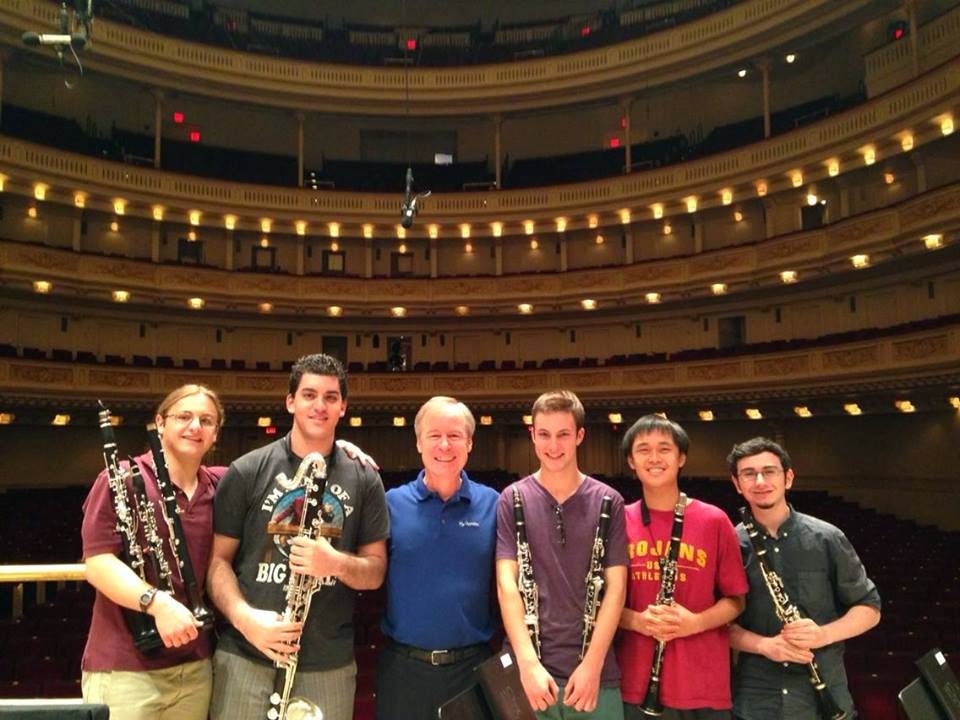
 As I look forward to playing with National Youth Orchestra again this summer I also look back at the time I spent with them last summer. I have so many treasured memories of summer, 2014. I remember wonderful colleagues, helpful staff members, incredible music, and concerts that surpassed anything I have ever been a part of, but one thing I remember most is you.
You are the most inspiring conductor I've ever had the privilege to play under. You brought such
energy to the orchestra (not that we were lacking before!), incredible musical ideas, and such an invigorating personality.
By the first day, you knew half of us by name, and by the second day you knew all of us. You hung out with us, and you always had the time to discuss musical ideas before rehearsal and after rehearsal, and you even ate lunch with us! I hope you know how much it meant for us to be respected and treated as equals and colleagues by such accomplished musicians as you and Gil Shaham.
 The incident that was the most touching to me happened after an early rehearsal of Pictures at an Exhibition, where we were first working on "The Great Gate of Kiev." During this rehearsal, when we got to the bassoon and clarinet chorale, you took it out of tempo and, I must say, you completely shocked me. I couldn't understand for the life of me why you would approach the chorales as you did, because I don't think I had ever heard the piece played that way.
After the rehearsal, I approached you, and I asked you what your rational was behind taking the chorale out of tempo. I think I may have been a little brash, and probably a little exasperated too because I was sure you must be wrong, but you seemed to take no notice and answered me happily and respectfully, and I thank you very much for that. You shared with me that you used to do both that chorale and one one that occurs a little later completely in time until a Russian conductor (I don't quite remember who you said it was) informed you that the chorale was derived from an Eastern Orthodox hymn, and wouldn't be sung in time originally, but would be performed with a lot of rubato and stretching of the tempo. We spent quite a while talking about this and other things, and you were so enthusiastic and excited about sharing your musical ideas and experiences with me that it was contagious! At the end of our discussion, you advised me to go listen to Rachmaninov's vespers, which you said would be a good example of what was intended with the chorale and how other, similar hymns, would sound were they sung. And so I did, and now, when I hear this type of chorale, I can approach it in a much more mature manner than originally I did before our discussion.
The reason I play music is because I love it more than anything else in the world. I love every part of it. The depth of ideas used in music are fascinating and one can find endless gems of information like this in music, which lead to more perspectives and views of music (and people) in a never-ending positive feedback loop. There are always new things to discover, hidden in pieces I have heard hundreds of times. Seeing that someone whom I revere, respect, and look up to can just love music, be so exuberant about it, and share that passion with me really showed me in a first hand way the power of music to connect people.
Thank you again for last summer, it was wonderful.
-Torin Bakke, clarinet NYO-USA 2014, NYO-USA 2015.
Wednesday, January 14, 2015
National Youth Orchestra of the United States
I was listening to the radio recently when Bernstein conducting Symphonic Dances from West Side Story came on. I really enjoy listening to Bernstein conduct Bernstein.

The music swelled through the beginning movements of the piece until the "Cha-Cha." In the story, this is where Tony and Maria meet and do a cute little dance. I wouldn't normally describe this part as the most emotionally-inspiring moment in the piece, but at that moment I was flooded with memories of playing this piece with the National Youth Orchestra of the USA this summer and I couldn't contain myself.
The National Youth Orchestra of the United States is a summer orchestra of 120 kids between the ages of 16 and 19. It was founded by Carnegie Hall in 2014 and involves an intensive two-week retreat at Purchase College in New York, where the participants work with various conductors and are coached by musicians from major orchestras around the US. During the second week of the retreat, a world class conductor and soloist joined for rehearsals - last summer it was David Robertson conducting and Gil Shaham soloing. The NYO-USA debuted at Carnegie Hall, and following that, went on a multi-city tour around the US.
NYO-USA was, to put it frankly, the most inspiring and influential musical and social experience of my life so far. Before NYO, I had never been in an orchestra where so many of the people cared so much for their art. In the rehearsal hall, everyone was constantly paying attention to matching everyone else's tone, intonation, rhythm, phrasing, style, articulation, everything! After most every rehearsal, several people (the ones who weren't scurrying off to get a meal after the long rehearsals) either stayed on the stage rehearsing or went backstage to work on their parts with each other! I grew used to requests from other musicians to tune this section, or make sure that other section was together.
Although these requests came quite often, they were never critical, the musicians just wanted to illuminate a problem or refine tuning or adjust some little something that was making the music we played together sound less good than it could. One time, Annie Wu, an incredible flutists asked me to stay after a rehearsal and work on the Bernstein.
I was playing Eb clarinet while she was on piccolo, which means we had several sections that we played together. If you ask anyone who knows anything about the piccolo and the Eb clarinet, they will tell you, that contrary to what composers seem to have thought, these instruments are more unsuited to each other than any other two standard orchestral instruments! Up to this point, when I had played Eb (or the little devil as I like to call it), I would attempt to match the piccolo and he or she would attempt to match me, and we would be closer than if we hadn't listened to each other at all, but we would still be quite far away in our pitch. Mostly, I concluded that it was impossible to really be in tune with the piccolo when I played Eb clarinet, so I didn't worry too much about it. Annie, however, had higher standards, and she was relentless. After a rehearsal, she came up to me and said "I think we're out of tune in some sections in the Bernstein, we should spend some time working on them." I agreed, and we got to work. I don't think I have learned more about tuning Eb clarinet than when working with Annie.
As a result of these collaborations, I learned a lot about listening to the other players in an orchestra, and I learned that I didn't have to ever settle for close enough. We could always make it better. That's probably the most important thing I learned this summer - that I still have a lot to learn, and that I can always make a passage of music a little bit better, a little bit more in tune, a little bit more colorful, and a little bit more excellent.
I have so many more things to say about the summer of 2014. It was incredible to work with David Robertson and Gil Shaham. I made so many friends, and learned so much, and had so much fun. It has been hard to figure out where to start writing about any of it, and it's already time for Carnegie Hall to choose the young musicians of this summer's orchestra. I applied again, and I hope very much that I will be selected, but if I learned anything from my NYO summer, it was that the US is filled with incredible young musicians many of whom will also be auditioning.
But I'm crossing my fingers...
Sunday, November 9, 2014
More than 1/2 way there!
When I was in sixth grade, I read Coyle’s The Talent Code and Gladwell’s Outliers. They argued that being good at most things was more a matter of work than the result of innate talent. So I decided to conduct an experiment. I began keeping track of my clarinet practice hours. My goal was to practice for 10,000 hours. Then, I would look at how far I’d gotten, to see if Gladwell and Coyle were correct.
This was the start of an amazing journey. I passed the 5000 hour mark this past summer on the NYO-USA tour, and as I look back, I can see how much I’ve grown as a musician, and more importantly, as a human being.
So much has happened! I’ve soloed with the Chicago Symphony Orchestra, performed at Carnegie Hall with NYO, and played the national anthem at a Chicago Bulls game. I’ve toured China, France, and Belgium as the principal clarinet of the Chicago Youth Symphony Orchestra and Midwest Young Artists. I’ve worked with amazing conductors like Carlos Miguel Prieto and David Robertson, and I’ve had lessons with incredible clarinetists such as Anthony McGill, Burt Hara, Steve Cohen, John Bruce Yeh, Wenzel Fuchs, and Stephen Williamson.
But what does this list really mean? Whenever I win an audition or a competition, I feel a surge of pride and self-accomplishment, but the defeats and the failures have probably taught me the most. I still remember getting third chair in my youth orchestra after spending an eternity practicing for the audition. I felt terrible, but I realized that losing an audition was an opportunity to focus upon how much I have left to learn.
At this point, I have 4,445 hours of practice left to reach that 10,000 hour goal. And then, who knows? Maybe I’ll take up ballroom dancing. But probably I’ll stick with clarinet because music has come to define who I am. I don’t know what all of this will amount too, but I know that I will keep on working and consequently keep on failing. As Stephen Dedalus said in Ulysses, “errors are volitional and are the portals of discovery.”
Saturday, April 12, 2014
Britten Movements for a Clarinet Concerto
Last year, I won the Chicago Symphony Orchestra Crain-Maling Foundation Youth Concerto Competition, granting me the opportunity to perform with the CSO this year. I played the Mozart clarinet concerto at the competition and I thought that I would probably be playing the Mozart with the CSO, but a few months ago they emailed me to tell me that they wanted me to play Movements for a Clarinet Concerto by Benjamin Britten. I had know idea that Britten wrote a clarinet concerto!
I did some research on the piece, and it turns out that Britten didn't ever complete it. It was originally commissioned by Benny Goodman in 1943, and Britten enthusiastically agreed to write it. He finished a good amount of the first movement before returning to England in the same year.
During his journey back home, his manuscript was seized by U.S. customs because they thought that it could be some sort of code holding military secrets. Unfortunately, even though Britten quickly retrieved his music, Goodman informed him that he should put the project on hold because Goodman was about to go on a tour with his band and would not be able to prepare the music for a while. Britten returned to England and sadly never finished the piece.
The Movements for a Clarinet Concerto was finished by recently by Collin Matthews and was first performed in 2008 by Michael Collins. Collins is a wonderful British clarinet soloist and conductor. You can find a copy of his performance on the 2009 album Unknown Britten. Matthews does a wonderful job playing the concerto with the Northern Sinfonia conducted by Thomas Zehetmair.
I am really excited to be playing this piece. I have listened to the recording of Michael Collins playing it many times. This is the only recording I have been able to find. My favorite movement is the second because of the gorgeous duet between the solo clarinet and the bass clarinet. Unfortunately, I was only asked to perform the final movement of the piece. I really love this piece and wish that I could perform the whole composition.
Perhaps this is best, because the Britten is a difficult concerto! I am having trouble just learning the last movement, let alone the whole piece. The hardest parts about the last movement are probably playing the high notes (this piece uses the highest practical notes on the clarinet). It is not easy to hit these notes and keep the style of the piece cute and exciting. It is easy to lose the musical line when you are trying to control those high notes.
Still, I shouldn't complain, because it is an incredible honor getting to perform such an amazing piece of music with a world class orchestra.
Monday, February 10, 2014
National Youth Orchestra of the USA
On Friday I found out that I have been honored with a spot in the clarinet section of the 2014 National Youth Orchestra of the USA. I think I've only been this excited twice in my life. The other was last year when I won the CSO competition.
The National Youth Orchestra is a recent phenomenom. Last year, Carnegie Hall's Artistic Director, Clive Gillinson, founded the NYO, which debuted at Carnegie Hall and toured London, Moscow and St. Petersburg. They played Shostakovich 10 and the Tchaikovsky violin concerto with Joshua Bell, as well as a modern piece composed for the orchestra called Magiya by Sean Shepherd. The orchestra played under the baton of Maestro Valery Gergiev, and they were pretty amazing.
I have found that I really connect with the people I play with in my youth orchestras, Midwest Young Artists and the Chicago Youth Symphony Orchestra. The same applied when I went to Interlochen when I was in middle school. With my orchestra friends, I can be really open about my passions and beliefs and ideals, about who I really am, and I can count on their understanding and acceptance.
So I am really excited to have this amazing opportunity to play with some of the best young musicians in the country. We will be playing under the direction of David Robertson of the Saint Louis and Sydney Symphony Orchestras, and we have the privilege of accompanying world class violinist Gil Shaham in the Britten Violin Concerto. This year's program will consist of the following repertoire:
Samuel Carl Adams - New Work
Bernstein - Symphonic Dances from West Side Story
Britten - Violin Concerto, op. 15
Mussorgsky, Pictures at an Exhibition (Ravel's orchestration)
And we will be performing in the following venues:
New York, NY - Carnegie Hall in New York City (July 22)
Lenox, MA - Ozawa Hall in the Tanglewood Music Festival (July 24)
Boone, NC - Schaefer Center for the Performing Arts in the Appalachian Summer Festival (July 26)
Chicago, IL - Jay Pritzker Pavilion in the Grant Park Music Festival (July 28)
Teton Village, WY - Festival Hall in the Grand Teton Music Festival (July 30)
Rohnert Park, CA - Weill Hall at Sonoma State University's Green Music Center (August 2)
Los Angeles, CA - Walt Disney Hall (August 4).
I can hardly wait!
Here is a link to the BBC Proms Performance from last year.
http://www.youtube.com/watch?v=51RbxksPGXw
Sunday, November 3, 2013
Greater Grand Forks Symphony Orchestra

Beverly Everett was conducting the concert. She is an active conductor, composer and performer as well as the Music Director of the Bismarck-Mandan Symphony Orchestra. She was a smooth conductor and easy to follow, and it was a lot of fun to play under her.
The Bott family, a local family involved with the orchestra, hosted us. They were very kind and accommodating, and they had a very nice home. They even went so far as to play legos with my five year old brother, Morgan, who drove to North Dakota with us. The orchestra, as well as being so kind as to ask me to play the Mozart with them, also asked me to play the clarinet part in Peter and the Wolf, which was really cool! The clarinet plays the cat in Peter in the Wolf, and it is an enjoyable piece to perform. Terry Dullum, a journalist with WDAZ News, narrated Peter and the Wolf and did a wonderful job.
To add to all their generosity, Beverly Everett, the guest conductor, invited me back to North Dakota in March to play the whole Mozart clarinet concerto with the Bismarck-Mandan Symphony Orchestra, which she conducts! I am really excited to play an entire concerto for the first time with an orchestra.
The whole experience was both fun and instructive. I learned a lot, and I'm really glad and grateful to all the people who spent the time and effort to organize this wonderful weekend.
Monday, October 21, 2013
Clark Brody Memorial
A couple weeks ago, I went to a service in honor of the life of Clark Brody, former principal clarinet of the Chicago Symphony Orchestra.
Clark Brody was born on June 9th, 1913 in Lansing, Michigan. He studied clarinet first at Michigan State University, and then at the Eastman school of music. Before he played with the CSO, he was in the Air Force Band and concert orchestra during World War II, and he also played with the CBS Symphony Orchestra from 1941-1950. He was principal clarinet of the Chicago Symphony Orchestra from 1951-1978 and played under the baton of Rafael Kubelik, Fritz Reiner, Jean Martinon, and Sir George Solti. He also was a clarinet professor at Northwestern University from 1972-1995. He died at the age of 98 in 2012.
I take piano lessons from Mr. Brody's niece Barbara Rubenstein, so I have had the opportunity to hear a lot of stories about Clark Brody. It is very interesting to learn about both the personal and professional sides of an individual. I attended the memorial with Barbara and sat next to her during the service.
The service was a very elegant celebration of Mr. Brody's career. Many people spoke about Mr. Brody and the impact he had upon them. I especially enjoyed his son, Robert Brody's, very graceful words about his father. The younger Mr. Brody described an incident in their life when they were travelling. They were walking through a park where there were many lepers who were obviously suffering. One of the sick men had fallen off a bench, and many people were walking past him ignoring him, even though it was obvious that the man was trying to get back onto the bench. Mr. Brody picked up the man, and put him on the bench, made sure he was okay and wished him a good day, as if it were the most natural and expected thing to do. John Bruce Yeh also spoke about Mr. Brody and how he was very supportive of the 19 year old John Yeh when he first took up a position with the orchestra. Mr. Yeh talked about how Clark Brody showed him how to play in an orchestra and guided him through his first few years.
Several people performed at the service. There was a clarinet ensemble made up of former colleagues, friends and students of Clark Brody, and Charlene Zimmerman performed the 2nd movement of the Mozart Clarinet Concerto with Toni-Marie Montgomery accompanying. Charlene Zimmerman is the principal clarinet of the Chicago Lyric Opera. I have never had the privilege of hearing her play before, and I found her quite wonderful. She played with a sweet, singing line, and it was one of my favorite interpretations of the 2nd movement. I think I may have to start saving my money for Lyric tickets...
Tuesday, September 17, 2013
Walter Grabner's Awesome Mouthpieces
I've been playing on Walter Grabner's amazing mouthpieces for a couple of years now. They have a really great sound, and I recommend them highly.
Also, Mr. Grabner is a really great guy. Last spring, I played at the Skokie Valley Concerto Competition. I was playing on one of his older mouthpieces. I didn't advance to the finals, but Mr. Grabner heard my performance, and he talked to me after the competition. He said I had done a great job, but he thought I should try out one of his newer mouthpieces that he had just developed.
 The first thing I noticed about them was that they have a realy beautiful, serious tone. They have a very smooth and resonant sound.
I said sure, I'd love to try a new mouthpiece, because I had the finals of the Chicago Symphony Orchestra Youth Auditions coming up in a week, and people often describe my tone as too bright. So I went to his studio a few days later and tried out some of his new mouthpieces. They were fantastic! They had a dark, mellow tone, and I really liked the difference. I picked the one I sounded best on, and when I asked Mr. Grabner how much it cost, he said that I could have it.
Well, a week later at the CSO Youth Audition finals, I won first prize. I'm sure that Mr. Grabner's new mouthpiece helped me get there. It is a seriously fine mouthpiece produced by a seriously fine man, and I recommend it to everyone.
Also, Mr. Grabner is a really great guy. Last spring, I played at the Skokie Valley Concerto Competition. I was playing on one of his older mouthpieces. I didn't advance to the finals, but Mr. Grabner heard my performance, and he talked to me after the competition. He said I had done a great job, but he thought I should try out one of his newer mouthpieces that he had just developed.

I said sure, I'd love to try a new mouthpiece, because I had the finals of the Chicago Symphony Orchestra Youth Auditions coming up in a week, and people often describe my tone as too bright. So I went to his studio a few days later and tried out some of his new mouthpieces. They were fantastic! They had a dark, mellow tone, and I really liked the difference. I picked the one I sounded best on, and when I asked Mr. Grabner how much it cost, he said that I could have it.
Well, a week later at the CSO Youth Audition finals, I won first prize. I'm sure that Mr. Grabner's new mouthpiece helped me get there. It is a seriously fine mouthpiece produced by a seriously fine man, and I recommend it to everyone.
Tuesday, July 9, 2013
Wednesday, May 22, 2013
Burt Hara Plays Mozart and Bruckner is Introduced to Two Kids from Chicago
Last month, I went to Minnesota to see Burt Hara play the Mozart Clarinet Concerto with the Minnesota
Orchestra in a lock-out concert put on by the musicians themselves, since the board of the Minnesota Orchestra refuse to pay for any concerts this year. This concert was unlike any concert I've attended before.
 |
| Photo by Nate Ryan LLC |
I'm from Chicago. Our Chicago Symphony Orchestra has an enthusiastic audience. We regularly give our orchestra multiple standing ovations. We applaud for the principals. We applaud for each section. We cheer, some of the older people say "Bravo," and we share a communal excitement for the music and the musicians that we love.
I'm used to standing ovations at classical music concerts. But the audience's response to the concert on April 25 was beyond anything I've ever seen. There were so many standing ovations that I couldn't count them. The scope of the emotion of the audience was tremendous, and it was amazing to be a part of all that. I cried. I couldn't help it. The music was beautiful, but the community was inspiring and heart-rending, especially considering that the Board of the Minnesota Orchestra is trying so hard to destroy the music, the musicians, and the community of the fans who love their orchestra. This even showed me first hand what a musical community is.
Now for the music. Mr. Hara's interpretation of the Mozart Clarinet Concerto was amazing. I have waited too long to review this concert to be as specific as I should about his performance. It was hard to write anything, because my emotions were too present, too strong, and my words couldn't possibly do my feelings justice. Mr. Hara's Mozart was sweet, technically perfect, and musically evocative. He told a beautiful story that is as strong today as it was 222 years ago when Stadler shared Mozart's genius with his audience. Mr. Hara deserves his reputation as one of the best clarinets in the world. He is really something special.
Onto the Bruckner. I was not familiar with Bruckner. I'd never heard a single one of his compositions live or on recording. I wasn't sure what to expect, but I was impressed. Often with a complicated symphony, you need to hear it a few times to sort out what is happening in the music and to truly appreciate it. The Minnesota Orchestra's presentation was the best introduction to Bruckner anyone could have. The music made sense to me and touched me from the first notes. The clarinet and horn solos wove through the entire symphony tying themes and ideas together with a beautiful sense of one uniting idea. I loved it.
I want to see more Minnesota Orchestra concerts, but I fear that the Board is destroying this institution forever, and denying everyone the ability to hear this amazing music. After a year of being locked out, the musicians are being forced to take jobs elsewhere to support their families. The orchestra is dwindling and will never be the same. And that makes me terribly sad.
Friday, May 3, 2013
Jorge Montilla
Last week, Venezuelan clarinetist Jorge Montilla came to Chicago April 19th and 20th to play with the

Chicago Clarinet Ensemble (CCE). He played a solo concert Friday night, gave a masterclass, and played with the CCE in a concert featuring him. Montilla is an amazing clarinetist whom I think is the best Eb player in the world. As one of the members of the CCE said, "it was like it was a real instrument." If you have heard many of us (like me) play the Eefer, you will understand how much of a compliment this is! It was a great weekend, filled with wonderful perforamnces, and I was so excited to get to be a part of it all.
I had met Jorge Montilla last summer when I went to a clarinet camp at which he was teaching. I learned then that he is not only a wonderful performer, he is also a great teacher!
The first time I saw Mr. Montilla during his recent stay in Chicago was on Friday during a CCE rehearsal for the concert on Saturday. He played beautifully, and during a break in the rehearsal, he came up to me, clasped me on the shoulder, and asked how I have been since he had last saw me. I was really happy that he remembered who I was!
That same night, I heard him play his solo concert. All I can say is, "Wow!" Mr. Montilla played the first half of the concert on Bb clarinet and sounded quite sublime. My favorite piece that he played in this part of the concert was an arrangement he made of Cierra Los Ojos y Eschucha by Piazolla. Cierra Los Ojos y Eschucha means "Close your eyes and listen" in Spanish. Before he played the piece, he asked us to do just that and try to imagine the beautiful mountains and plains of Argentina that Piazolla was trying to capture when we wrote this piece for solo violin. The thing about Jorge Montilla's playing that stuck out the most was his vibrato. I have never heard any other clarinetist ever play with such gorgeous vibrato in all of my life. Don't get me wrong. Many clarinets use a very good vibrato, but Montilla's stands out over anything I have heard. It is as wide and as colorful as the vibrato of any string player, and it gives his music a very distinct, personal and intimate sound.
For the second half of the concert he played the Eb clarinet. He played every piece with such vibrancy that everyone in the hall was completely captivated by every note he played. My favorite piece was the Alfred Prinz Sonata for Eb Clarinet and Piano. The first and third movement are very beautiful and the second movement is incredibly fast (hence the title "As Fast as Possible"). My favorite movement was the fourth. Most of this movement is Rossini opera and overture melodies with brief virtuosic interludes. Near the end there is an excerpt from Strauss's Till Eugenspiel in which there is a very famous Eb clarinet solo. The effect is very funny, and I found it quite entertaining. The Prinz is a really fun and exiting piece of music. I have to say that every piece Mr. Montilla presented was executed with style, beauty, transcendent musicality, and the flying technical proficiency that marks him as a world-class clarinetist.
For the second half of the concert he played the Eb clarinet. He played every piece with such vibrancy that everyone in the hall was completely captivated by every note he played. My favorite piece was the Alfred Prinz Sonata for Eb Clarinet and Piano. The first and third movement are very beautiful and the second movement is incredibly fast (hence the title "As Fast as Possible"). My favorite movement was the fourth. Most of this movement is Rossini opera and overture melodies with brief virtuosic interludes. Near the end there is an excerpt from Strauss's Till Eugenspiel in which there is a very famous Eb clarinet solo. The effect is very funny, and I found it quite entertaining. The Prinz is a really fun and exiting piece of music. I have to say that every piece Mr. Montilla presented was executed with style, beauty, transcendent musicality, and the flying technical proficiency that marks him as a world-class clarinetist.
Sunday, March 31, 2013
Crain-Maling Foundation's Chicago Symphony Orchestra Youth Auditions 2013
Yesterday, I won the Chicago Symphony Orchestra Youth Auditions!
 This means that next year I will get to solo with the Chicago Symphony Orchestra 4 times!!! It was a great experience playing the Mozart Clarinet Concerto in Orchestra Hall at Symphony Center. The six other finalists (Elizabeth Chang, Max Farbman, Sarah Householder, Allison Milligan, Saayujh Ramanathan, and Nicolaj Reiser) were all amazing and it was an honor and a privilege to play in a competition with all of them.
I want to give an especially exuberant shout-out to fellow Midwest Young Artists Symphony Orchestra member and first alternate in the CSO Youth Auditions: Sarah Householder. She played the third movement of Ewazen's Concerto for Marimba in which the percussionist uses four mallets (two in each hand). You would think that this would be difficult enough. But for Sarah, it became even more difficult when towards the beginning of her performance, the ball on one of her mallets broke off! In spite of her mallet breaking, she wasn't fazed. She gave a brilliant performance. Because she couldn't play with the broken mallet which was now just a wooden stick, she compensated. She switched the broken mallet around so that it was playing the less important notes in any section. She hit the notes she thought were most important so as not to break up the phrases any more than necessary. Amazing!
I am proud to say that I play in an orchestra with someone as capable, musical, talented and cool under stress as Sarah.
The CSO Youth Auditions were a great experience for everyone there. I am happy to say that I didn't feel quite as nervous as I normally do when I perform. I think I'm starting to get used to this performing thing. That's a really good thing.
-Torin
Saturday, February 16, 2013
1/3 of the Way There!!!
As of February 16, 2013, I have practiced over 3,333 hours. That means I am 1/3 of the way to my goal!
Here are some videos that document my progress.
Here are some videos that document my progress.
3,000+ Hours, Mozart Clarinet Concerto I. Allegro
9th grade, age 15 (2013)
2,000 Hours, Rossini's Introduction, Theme and Variations
8th grade, age 14 (2012)
1,000+ Hours, Weber Concertino
7th grade, age 13 (2011)
200+ Hours, Finzi's Five Bagatelles III. Carol
5th grade, age 11 (2009)
Tuesday, January 22, 2013
Chicago Youth in Music Festival

Monday night I had the opportunity to rehearse under the baton of Miguel Harth-Bedoya with the Chicago Youth in Music Festival Orchestra at Symphony Center. The Chicago Youth in Music Festival is celebration of the achievements of young musicians across the Chicago area. Local high school students are selected in an audition process to play with mentors from the Chicago Civic Orchestra in a collaboration. We auditioned in the fall, and we rehearsed through December and January with Cliff Colnot, a conductor, educator and musician and the Principal Conductor of the Civic Orchestra since 1994.
The experience was supposed to culminate in an open
rehearsal with Maestro Riccardo Muti, the Chicago Symphony Orchestra's
conductor and music director. We were all pretty excited about getting
to play with Maestro Muti. He is an amazing conductor and one of the
best known known musicians in the world. Unfortunately, Maestro Muti
came down with the flu and had to cancel all of his appearances this
week. We were all really disappointed. But, Maestro Miguel
Harth-Bedoya agreed to substitute for Muti at the last minute. He is a
Grammy-nominated and Emmy Award-winning conductor who will soon be the
Chief Conductor of the Norwegian Radio Orchestra in Oslo. Now he is the
Music Director of the Fort Worth Symphony Orchestra and the Founder and
Artistic Director of Caminos del Inka, a non-profit dedicated to
performing and promoting the music of the Americas. Maestro
Harth-Bedoya was an amazing conductor.
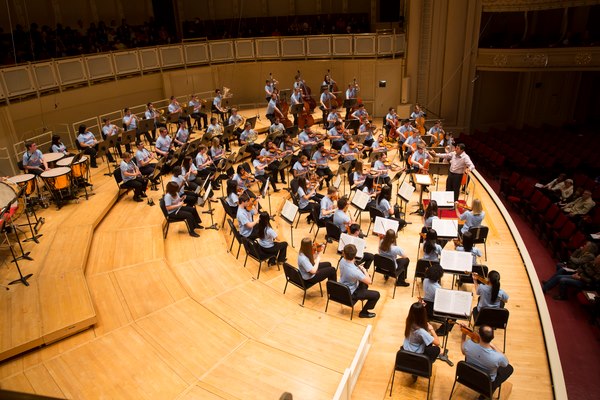
Throughout the rehearsal, the thing I noticed most
about maestro Harth-Bedoya was that he did everything with a lot of
emotion. You could tell he was immersed in the music, and that helped
me get immersed in the music too. During the rehearsal, you could tell
that the orchestra was befitting significantly from his advice. Another
great part of the experience of playing in the festival orchestra was
the advice Joe gave me on playing second clarinet. For example, he told
me I had to play louder than the first clarinet whenever I was playing
the lower octave in a section. This allows his high notes to have a
solid base to float over. I always thought that 2nd clarinet would play quieter than 1st clarinet, but Maestro Harth-Bedoya made a very good point, because the lower register doesn't project like the upper register.
The best part of the experience was probably getting
to play in an orchestra of that level and getting to play in an
orchestra that has a reasonable amount of people. My orchestra is huge!
For example, it has 6 clarinets, 7 flutes, 6/7 oboes, and 4 bassoons.
In an orchestra of that size, you aren't anywhere near as exposed as
you are in an orchestra with two winds on a part. Also, you don't have
to play as loud when you have solos because there are less strings to
play over. I loved playing in the orchestra, and I hope I'll have
another chance to play in the festival orchestra in two years when it
meets again.
Broken Clavicle!
I haven't written since November, but here's what has been happening with me.
A few weeks ago I broke my clavicle playing volleyball! This made practicing over winter break very difficult.
The worst thing was that I had the Walgreens concerto competition at the end of the month. After breaking my clavicle, I took about a week off of practicing to rest. The next week, I could practice a little without too much pain, and so I spent the next week gaining back everything I had lost during my break. This caused me to lose an effective two weeks of practice right before a competition!
Even after I started practicing again, it still hurt and so I couldn't practice as much as I would have liked the week before the competition when I was back at back level I was playing before my injury. After my performance at the competition, I felt that I did the best I could do in the situation. I got honorable mention, so I can't complain. but I wish I hadn't injured myself so I would have had more time to prepare for the competition. Maybe next time, I'll listen to my doctor when he says not to play any sports.
 |
| Making pizza in my clavicle brace. |
A few weeks ago I broke my clavicle playing volleyball! This made practicing over winter break very difficult.
The worst thing was that I had the Walgreens concerto competition at the end of the month. After breaking my clavicle, I took about a week off of practicing to rest. The next week, I could practice a little without too much pain, and so I spent the next week gaining back everything I had lost during my break. This caused me to lose an effective two weeks of practice right before a competition!
Even after I started practicing again, it still hurt and so I couldn't practice as much as I would have liked the week before the competition when I was back at back level I was playing before my injury. After my performance at the competition, I felt that I did the best I could do in the situation. I got honorable mention, so I can't complain. but I wish I hadn't injured myself so I would have had more time to prepare for the competition. Maybe next time, I'll listen to my doctor when he says not to play any sports.
Sunday, November 18, 2012
Private Lesson with Burt Hara
 |
| Burt Hara, and me, and Mr. Hara's Dog |
He was very energetic and enthusiastic, in spite of the fact that he with the rest of the Minnesota Orchestra is locked out. This is very sad, because the Minnesota Orchestra is a really great orchestra. I was disappointed that I couldn't see them play while I was in Minnesota. I think the administration of the Minnesota Orchestra should resign, because they aren't doing the one important job that they are supposed to do, which is to provide the musicians with the opportunity to share their beautiful music with the people of Minnesota, the Midwest, and the world. For more about this depressing situation, you can check out the Musicians of the Minnesota Orchestra website. http://www.minnesotaorchestramusicians.org/
Back to the lesson. Mr. Hara didn't work on technique of any kind. Instead we worked on the style of the piece and how to tell a story with my music. I started the lesson by playing the second movement of Finzi's Five Bagatelles. After I finished, Mr. Hara asked me what I was thinking while I played. I didn't know exactly. His response was amazing. He said that he thought I was thinking like this: "My tone is amazing! I am playing beautiful dynamics. Oh look! A crescendo, I will increase the level of my sound by this many decibels." Mr. Hara said I was thinking things like "Isn't my playing just wonderful. Listen to my beautiful clarinet playing!"
This made me laugh. But he was very serious, and he was right!
Mr. Hara said, "What you need is a good director of your movie." Then he asked me what story I wanted to tell when I played the Finzi Romanze movement. The only answer I could give him is that the movement seemed sad. Mr. Hara said that when he listened to this piece or when he plays it, he sees an old man. This old man is on the brink of death and wistfully remembering the life that he has lived. Mr. Hara then proceeded to start acting like an old man as he sat in the chair next to me. He put his head in his hands and wept dramatically, and he acted out his role as I played the piece. His dramatic enactment of the story helped me imagine the story as I played.
We worked through almost every measure in the piece, trying to get that feeling of reminiscence. After we worked on the piece, my playing became twice as good on the Finzi as it had been. Suddenly, I knew where I wanted each phrase to go, and I had an idea of what I wanted to express when I played it.
I loved Mr. Hara's teaching and was excited when he asked to hear another piece. So I played Rossini's Introduction, Theme and Variations. Again, we didn't work on technique of any kind. Instead, we talked about the music. First he had me play through the introduction, theme, and first variation. Then we went back to the beginning and he asked me what story I was trying to tell. The only answer I could give was that the piece was happy. Mr Hara said that I should know before I begin what kind of story I am trying to tell. I should have a character in mind, and everyone should know from the first note of the piece who I am. Mr. Hara said that he thought this piece was about a young girl who is extremely cute, innocent, not very smart, and quite a bit flirtatious. He told me to start playing, and while I was playing, he started flitting around the room, acting like a young girl, flipping his hair and twittering about.
Mr. Hara's acting really helped me get the feel of the piece, and we worked though the entire introduction, trying to tell the story of this young flirtatious girl. Every part of my playing was better when I focused on trying to tell a story. My technique even improved! My high notes sounded less squeaky, my articulation better matched the piece, and the phrasing had a reason behind it. During the only hour and a half I spent learning from Mr. Hara, my playing really took off. I took home many new ideas about the pieces that I played. And best of all, practicing like this is so much fun! The lesson with Burt Hara was probably the best lesson I have ever had on clarinet And that is saying a lot, because I have had the chance to work with some pretty amazing teachers!
Tuesday, October 30, 2012
Performance Last Spring at the Chicago Cultural Center
Music is extremely important to me, because with music I can express my thoughts and emotions in a way that everyone will understand, regardless of language or culture. Music is a language that everyone speaks. I love playing the clarinet, because it just makes me feel happy to do so. It is as if I am transported to another world where I don’t have to worry about anything, and I can just enjoy the wonder of living. Without music, my life would be a wasteland. Music is the most important thing in the world to me, because it makes me feel what nothing else can make me feel, and it allows me to tell the world what I think in a very personal way.
Making music with others is an
amazing way to learn about people. In a chamber
ensemble, for example, it is enjoyable to see how different people interpret
the music in an intimate setting. Everyone
has different ideas about the music and different ways of carrying their ideas
out. It is really interesting to listen
to the outcome of a chamber piece, when each voice sounds together in
performance. Playing with an orchestra
is a similar, but grander experience. When I am playing in an orchestra, the sounds
of the orchestra pours into me and give me incredibly real thoughts of anger, bliss,
depression, depending upon the composer and work of music. I love playing music with other people.
Subscribe to:
Posts (Atom)

